Monday, November 22, 2010

Invitaion For Death Anniversary

Role, What is NOT an RPG? Abla Manifesto

In recent weeks I have been discussing with some friends and colleagues what an RPG. Personally I think the concept has been distorted a bit with the arrival of countless games, card games and video games, mainly aimed at large audiences. I know I exaggerate when I say that sometimes even prostituted the concept, but it me da risa cuando algún conocido me dice "¡Pero si lo han convertido un poco en un juego de rol!" cuando se refería a que en un juego podemos personalizar al personaje en aspecto o si simplemente sube de nivel y adquiere habilidades conforme juegas en una partida. Vale, son conceptos clave que pertenecen a este tipo de juegos, pero para nada me parecen juegos de rol con el simple hecho de incluir algunos de estos elementos. Pero, ahí está la pregunta, ¿Qué elementos debe tener un juego de rol?
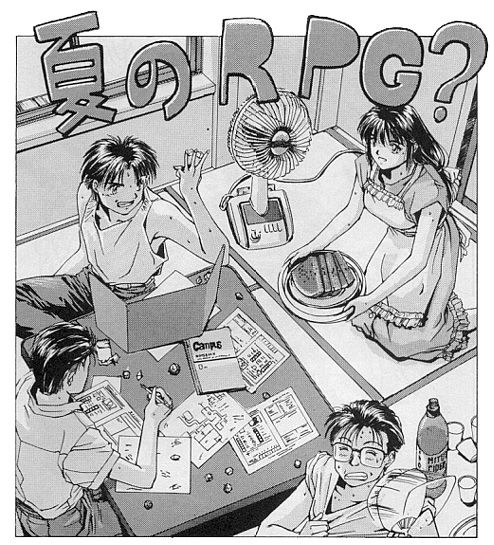
#1 Personajes

Es el elemento central de una partida de rol. En estos juegos encarnas a un personaje: desde un guerrero who fights against hordes of orcs, to a private detective who investigates bizarre cases through the jedi that falls prey to the delights of the dark side of force. The possibilities are endless depending on the ambientación.Tus characters can level up and gain skills and learn from the experience. However, putting a character involves a personal and psychological dimension: the character's personality.

That a game (whatever), including characters, does not make an RPG. These characters can level up too, but if your only goal is to improve and improve, if you just want to accumulate and fall into line, for me that is not role. It's another thing. Many games are sold as "role" simply for the fact that the character in you can level up.


Auditore Ezio is a great character with an interesting history. But make no mistake, what you do in the game is very limited. Simply you do to move forward and build strategy and tactics. You do not get to decide just what you want or not want to do and thus shape the character to your liking.

# 2 History

An important story. But most important is that the course of your actions marked the passing of her history: whether you let free the evil tyrant, freeing it claims to be repentant or deliver it to the authorities, entered the barracks "to sack" or wait night comes, build runways or go "the first thing that happen to catch" the ability to decide is typical of an RPG. True

generate a complete game with free will is complicated, but at least there are several possibilities to act according to the personality of your character.

The Final Fantasy franchise has always been sold as a classic RPG (role playing game). But in them the capacity for free will is low. They have a spectacular story and complex characters, but you do not decide anything ... The story follows its course through it alone.

# 3 Atmosphere

Every story, with characters included, must have a substrate on which to build. But a great atmosphere alone is not enough. It should be able to interact with her as the character and history belong to that setting.

I doubt that in games like World of Warcraft, with a great atmosphere and much to discover, can influence significantly in it and make your characters created beings are interesting in terms of morality and ethics.

# 4 Immersion

The latter is somewhat relative because it depends on each one. But for me it is essential that an RPG might be able to immerse yourself in history and ambience, make you become one more part of the intricate mechanism which is the mixture of story, characters and setting. If not intended to include you in, I can hardly put it inside.


Many games like this in D & D (inspired by RPG) contain aspects typical of an RPG: characters better, and the odd pseudo-alternatives (minimum). But do not get into context nor intended.

Maybe set the bar high, but to me a role-playing game will always mean the same thing. Being with friends one afternoon thinking you're a powerful wizard or a burly swordsman trying to see how to sneak into the dragon's lair or liberating the city from a dangerous thieves' guild. And that experience is irreplaceable ...

While others may be equally fun, I doubt that either.

Thursday, November 18, 2010

Antimicrobial System In Mouth


to me that I have barely begun to crawl so the medical world, I see what ICT can offer in the health field. This is starting to move and who knows when it will become in a few years when you are exercising, but I have something I have it clear, health 2.0 ask me too.

32 years since Alma-Ata

of the community met for the first time in September 2010 with the first two conferences on Health 2.0 in Seville and Granada, and has been reunited at the recent Health 2.0 in Abla (Almería) in late 2010, the initiative comes # salud20Andalucia .

But # salud20andalucia has become much more than a label a successful application (Twitter ®), # salud20andalucia germ is an open group visionary, collaborative, enthusiastic, where each brings his vision as a citizen and professional and where contributions are not limited to Andalusia but is open to the global community with national and international interests.

Del collective ideology comes this manifesto .

The members of this group are convinced of the need to move towards a new socio model more sustainable, participatory and democratic development in the relations between citizens, professionals and organizations are necessary and timely health redesigned to achieve a more accessible and nearby.

think the Health 2.0 concept must be understood as a change in organizational culture supported by a horizontal and collaborative design compared to traditional thinking and hierarchical pyramid.

health institutions can and should harness the potential of this new change of 2.0 health model for what can count on the professionals who have already taken steps in this regard.

On these ideas are written these lines of work thus become our proposal for starting the renewal of health following the pattern that emerges from the Web 2.0.

For Citizenship:

citizens under the principle of patient autonomy, as enshrined in the Statute of the patient, are co- responsible for their health, so that their active participation is essential to both health care and in improving the health system.

should respect and promote the citizen self-organization in online communities. There is no better empowerment that arises spontaneously and independently.

talks to citizens about their health and the health system should not be understood as threats by managers or professionals, but as a great opportunity for improving the system.

The participatory citizenship not expect to be asked to review and assess the quality of services. The opinions arising in the network are a flexible and valuable for the continuous improvement of the health system. Organizations can not be limited to traditional assessment systems.

technologies offer opportunities and solutions. All of them must be to serve the needs citizens, regardless of institutional agendas. If not, could become an obstacle in improving the health system.

The solutions must be technology simple, manageable and accessible . Before deploying an application must assess whether it meets these premises. The formation of citizenship is a prerequisite for success.

institutional initiatives with technological support, when not taken into account in public, often fail to move into real practice, so it should be raised from his view , Which will adapt to their needs and expectations .

Before consolidating general solutions must be built local experiences . The method experimental is not only the most suitable for scientific knowledge, also for design services. The Living Lab experience should serve as a model Abla.

The citizens excluded and disconnected from society in solutions based on Web 2.0 should be integrated, as are most in need of health services.

The first step towards transparency is clarity . And information services should be easy to find, use and understand.

For Professionals:

Set mechanisms that facilitate collaboration and knowledge sharing through the use of professional networks, as they are they have sufficient information and knowledge to improve their services.

The self-organizing socio professionals , along with citizenship, should be a fundamental pillar of change. The local community has become a social space for innovation to lead the change.

The debate professionals around the healthcare system should not be seen as a threat by managers or politicians, but as a great opportunity to improve the system itself.

Internet is a way to improve the relationship between citizens and professionals . Collaborate on the network target services to citizens and to share experiences, strengthens the common growth.

Momentum the use of Internet and new technologies is essential to organized or sponsored improving the health system.

Technological solutions must be accessible for everyone. organizations should provide and facilitate access regardless of place of work and qualifications.

Security can not be an excuse for access to the Internet. Should be a right exercised by professionals from responsibility , without censorship or limitation.

The use of technology must respect the right to privacy , honor and reputation. All users citizens and professionals must ensure these rights, according to the terms established by law.

training on new technologies is a right and obligation of all professionals. Such training should provide adequate incentives for promoting the transfer of knowledge and development of new skills.

should strengthen their strategies networking through specific initiatives related to professional practice and collaborative technologies favoring two-way relationship with patients.

Authors: # salud20Andalucia, @ cuidadorasnet, @ pacoxxi, @ alorza, @ randrom, @ luisluque, @ marianoh, @ lineros55, @ emilenko, @ moilafille, @ andonicarrion, @ carlosnunezo, # comisiongestora, @ Juany_Olvera, @ goroji, @ rafacano, @ manyez, @ cuidando_es_sfs, @ bbelizon, @ Perielvampi, @ EnferEvidente, @ JuanOdM, @ flupianez, @ CarlosMatabuena, @ Ebevidencia, @ spanamed, @ drajomeini, @ jbasago, @ alesmismo, @ ntonio_Reina, @ fradiex, @ natho47, @ enfermera2pto0, @ gallegodieguez, @ clarabermudez, @ Bacigalupe, # healthglobal, @ @ DCCU bainab, @ carlosgurpegui, @ lolavellido
This document is a collaborative writing from "Decalogue for ciudadanocéntrica health", in Alberto Ortiz de Zarate, "Health systems closer", chapter of "Health 2.0: ePaciente and social networks, Vodafone Spain Foundation, 2011.

For comments please visit the accessions

Creative Commons Attribution (by) : It allows any exploitation of the work, including commercial purposes, and the creation derivative works, distribution of which is also permitted without restriction.

Tuesday, November 2, 2010

Cervical Mucus Large Snot

Franz Kafka (3 / 10)


(blogger resumes operations after a while "busy" with the return of the bonds. Be brief, but just to give more)

Talking Prague and not talk about Franz Kafka is like talking about Paris and not to mention Victor Hugo or Alexandre Dumas. This writer, author of the novels The Trial, America, El Castillo and the short story that surely know: The Metamorphosis, has greatly influenced the literature of the century XX and in many languages \u200b\u200bthe term "Kafkaesque has emerged to describe situations or similar views to those of the Czech writer.

Kafkaesque , na .

1. adj. Pertaining to Franz Kafka or his work. Kafkaesque novels

2. adj. Characteristic of this Czech writer or his work. Vision Kafkaesque world

3. adj. The a situation: Absurd, anxiety.


Royal English Academy © All rights reserved

Kafka's work is harrowing and expressive, trying to show entrapment and alienation of modern man, the change of times the writer lived. Of his works published posthumously and enormous material is removed the image from a weak, sensitive and sad, but that should not be interpreted literally.

It is true that Kafka's life was marked by a relationship with an authoritarian father bullied him for much of his life and his disease, tuberculosis . Much of the work of this man, like many other writers, go unnoticed and hidden for many during his life and was not published until (and after his death), when it reached the fame that is now attached to it.

I do not want to sin "gafapastero" but it is a work that I have yet to read and it made for Czech lands journey has to start getting interested.